
Wegotism: the generic "we"
essay

“I am he as you are he, as you are me
and we are all together
See how they run like pigs from a gun,
see how they fly
I'm crying”
~ The Beatles, from “I Am the Walrus”
For the spiritual path of Kaballah, “we” is a significant word associated with being wise because a ‘station’ or ‘place’ (in Hebrew Chokmah) in the Tree of Life represents “wisdom.” In short, a key aspect of “wisdom” is thinking in “we” because it is wise to think beyond mere personal desires. As example, when making decisions or planning to do something, rather than simply considering “I”, one considers “we”. “I” may want to remove a bush from the yard but “we” knows that birds shelter in there, so “I” relinquishes its plan.
“I” is, for the most part, a word equated with “ego.” At times “I” is a helpful and necessary indicator in society. A friend asks, “What are you doing today?”… “I have to get to my car inspected.” Yet beneath the surface or under the hood, that’s a lie because the mechanic will do the inspecting and the car is made of various metals mined from the Earth, hence “I’d” be more accurate saying, “We have to get our car inspected” . . . in which case “I” am speaking for “we”… which includes the mechanic, the metals, glass, rubber, plastics, etc.
According to Geraldine Patrick Encina (of Mapuche and Celtic descent), “In general, indigenous minds have been culturally induced/educated/motivated to discern what information from the natural world is relevant in order to maintain or recover collective harmony—and never to secure immediate individual satisfaction. …
“The corpus of knowledge and wisdom enables human groups to contribute in a creative way to the overall purpose set by their anteceding generations: one of building endurance and resilience with the ecosystem they inhabit, so to become a single entity which we call a socioecosystem.”
In context, a key phrase there is “the ecosystem they inhabit," which implies that different methods and ways work in different locations—one size clearly does not fit all. And “anteceding generations” shows one’s decisions can be based on both conscious learnings from ancestors as well as unconscious innate DNA impulses. Suddenly “I” becomes “i”.
A current generic “we” train of thought is: ‘We can stop climate change by doing so-and-so,’ but that’s almost assuredly ignorant at best, and “bright green lies” propaganda at worst—as each locale or habitat has specific energies.
Use of “I” is fraught with ego and since “we” is often made of a bunch of “I”s, “we” too can be used as such, hence wegotism.
(As an avid portmanteau-er, i wish i had come up with that word, but when researching the root of “we” for this essay, there it was!)
When speaking or writing, there is a time and place for “we”, yet i often notice in people’s writings what i call the “generic we”— generic b/c it either does not speak for me personally and/or euphemizes actual histories, actual truths; that type of usage of “we” genericizes what begs for distinct clarifications, and that “we” assumes a level playing field when there are hills.
Referring to London the city, award-winning novelist Elif Shafak, whose Substack i read and appreciate, recently wrote in her post: "As we expanded our cities, especially in the 19th and early 20th centuries, we called some rivers too polluted (without recognising our own role in that pollution)…”
What “we” is she referring to? What “our” is responsible? Surely Indigenous Peoples – with the cleanest track record for caring for Earth, Waters and “All Our Relations” – are not part of that “we/our”. Some might say…Well, it’s tacitly understood that she meant “humanity” in general, but i strongly object because such usage glosses over deeper understandings and homogenizes everyone into the same “we are all one” pool, when in fact we are all interrelated . . . with differences that must be acknowledged and respected. Generically and in the cosmic big picture “we are all one” family yet day-to-day “we” are not “all one”—blind uniformity can be a stepping stone to religious fervor or Nazism.
propaganda “we”
Trying to lure readers into feeling like part of an all-inclusive club is a corporate journalistic headline trick often employed with headlines such as “What We Know About...” This is slickly deceptive because it assumes an accuracy and obedience to what is known without questioning the integrity of the journalist and/or publication.
Another example i’ve heard many times from left-leaning journalists and even comedians is including themselves in the atrocities by identifying with the United States. For a paraphrased example, ‘When we attacked the Iraqis, it was a disgrace to our country.’ Well, i didn’t attack the Iraqis! And why are you associating yourself with warmongers while simultaneously admonishing them?
Perhaps such usage of “we” can be traced back to the Preamble to the Constitution which begins: “We the People of the United States, in order to form a more perfect Union, establish Justice, insure domestic Tranquility…”
First off, things are seriously lacking in the “insure domestic Tranquility” department, especially since it’s a capital T. Yet more to the topic at hand, where’s the Native perspective?… not only the Peoples and Nations here long before “the United States,” not only that the very same Constitution does not revoke the Declaration of Independence’s reference to “merciless Indian savages”—yet also that the “we” actually includes trees, water, birds, air, soil and all manner of other living beings whose quality of life has gone down or gone away since those famous or more so infamous words were penned.
The usage of “we” is not an absolute. If you use “we”, consider who you are actually speaking for or to . . . so as to see if it is accurate or not. Speaking to is more likely accurate.
As example:
"We need to stop learning about the Earth and start learning from Earth." ~ Tiokasin Ghosthorse (Lakota).
In this case, my interpretation is that conditions are so awful that he is making a kind of plea to humanity whose actions in toto he considers misguided, the conditions with Earth proving that. Also, there is a distinct difference between learning heady information “about the Earth” and a direct experience of living with, feeling the energies of and learning “from Earth.”
Mother Earth is the greatest teacher of “we” because “we” all must get along with Her so as to survive. Generic usage of “we” can be inaccurate at best and otherwise deceptive, perpetuating false narratives that continue to herd humanity onto dangerous and destructive pathways. Because “we” is such a significant word, it deserves scrutiny as to its contextual usage.
“Strangers passing in the street
By chance two separate glances meet
And I am you and what I see is me
And do I take you by the hand?
And lead you through the land?
And help me understand the best I can?”
~ Pink Floyd, from “Echoes”
with thanks to Steven Newcomb (Shawnee, Lenape) for a couple of ideas that helped with embellishing the misuse of “we”
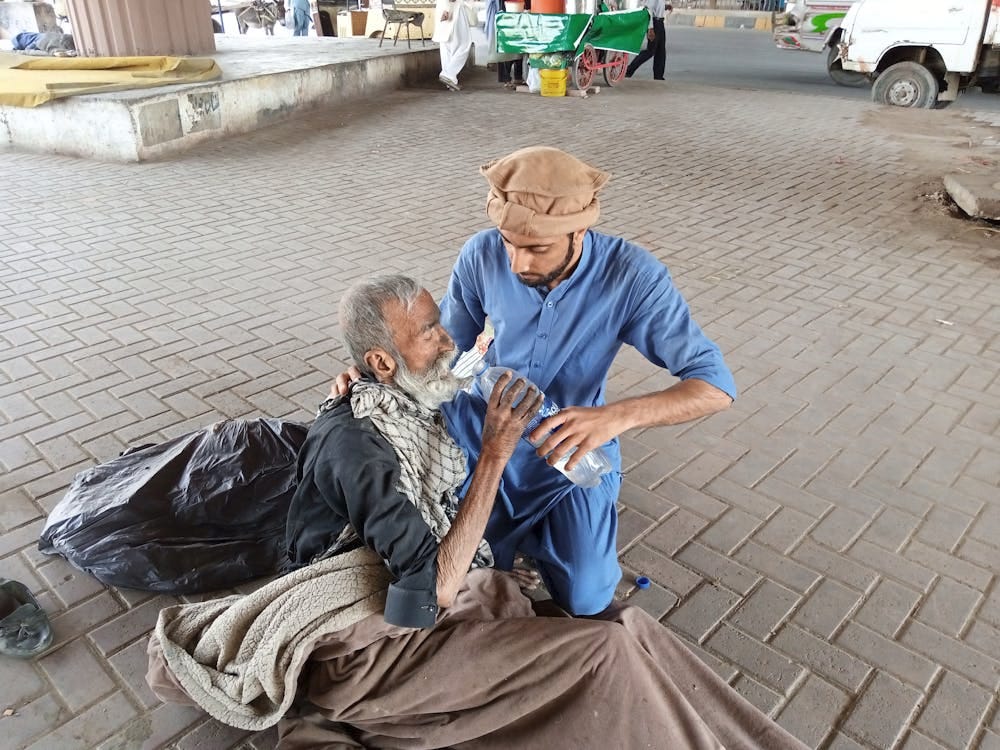
(photo: Karachi, Sindh, Pakistan “Man In Blue Clothing Giving An Old Man Water”)
Mankh (Walter E. Harris III) writes, publishes, gardens, travels a holistic mystic Kaballah-rooted pathway staying in touch with Turtle Island. To find out more about his writings, publishings, podcasts, presentations at . . . . Allbook Books
Enjoyed your essay on "Wegotism"--it does really seem that the egotistical narcissism of our society has inflated from the 'I' to the 'we'! I like Rosenstock's phrase: "The second person ('You') is the principle of mental health." You might enjoy my short piece about him:
http://www.theimaginativeconservative.org/2018/10/cross-of-reality-eugen-rosenstock-huessy-caryl-johnston.html
Good distinctions. And there's also "I and I" . . . .